
Scorpion performing his iconic Toasty Fatality on Sub-Zero, in Mortal Kombat X.
Scorpion performing his iconic Toasty Fatality on Sub-Zero in Mortal Kombat (2011).
In the longtime Mortal Kombat series of fighting games, a Fatality is a special finishing move that can be used against one's opponent at the end of the final match after they have won. When the announcer says "Finish Him" or "Finish Her" depending on the opponent's gender, the victor can choose to kill the loser in a gruesome manner through a Fatality move. If input correctly, the background will darken, followed by the desired result.
In certain games, a Fatality may be allowed at points during the match due to a modifier, such as the Dizzy Fatality Kombat Modifier. This modifier causes either player to go dizzy and allows the opponent to kill them with a Fatality for short periods throughout the match. Inputting the Fatality ends the match regardless of the rounds left, health, or who is winning or losing. In these scenarios, the game will award the win to the performing player, even if they were losing beforehand. Whether achieved through standard play or a modifier, a Fatality always marks the end of the entire match.
Unlike special moves, a Fatality may require certain distances and quick button sequences in order to achieve the desired result. For example, in Mortal Kombat 3, one of Sub-Zero's Fatalities requires that he stands close to the opponent and quickly execute Block, Block, Run, Block, Run. Every character has their own special Fatality that must be performed at a certain distance from the opponent. The number of Fatalities varies depending on the game: while characters in Mortal Kombat and Mortal Kombat: Deadly Alliance had only one, Mortal Kombat 3 and its updates featured as many as four.
In the 1995 movie, the word "Fatality" is actually said only once by Shang Tsung.
Due to its popularity, Fatality-like finishing moves inspired by the Mortal Kombat series have also appeared in other fighting games from Midway (Killer Instinct, War Gods, Bio F.R.E.A.K.S., Mace: The Dark Age), and many other companies (Blood Warrior, Tattoo Assassins, Way of the Warrior, Primal Rage, Samurai Shodown IV, Deadliest Warrior: The Game, Eternal Champions, Kasumi Ninja, Time Killers, BloodStorm, etc.), though they are not usually named as such.
Conception
While creating the original Mortal Kombat in 1991, co-creators Ed Boon and John Tobias started with the idea of a Street Fighter II-like system and retained many of its conventions, but tweaked others. The most notable additions were graphic blood effects, more brutal fighting techniques, and especially the fatal finishing moves (this was a novelty at the time as the traditional fighting games ended with the loser simply knocked unconscious and the victor posing for the players).
According to Boon: "It started with an idea to enable the player to hit a dizzied opponent at the end of the match with a "free hit", and that idea "quickly evolved into something nasty".
According to Tobias: "Our first idea was to use them as a finishing move for the final boss, Shang Tsung, who was going to pull out his sword and behead his opponent. Then we thought, "What if the player could do that to his opponent?" When we watched players react to the Fatalities, we knew we had no choice but to give them more."
Other Finishers
- Animality - This finisher allows the player to morph into an animal and maul or eat their opponent alive. This style of Fatality debuted in Mortal Kombat 3. Some say the precursor to the Animality was Liu Kang's Dragon Fatality from Mortal Kombat II, in which he turned into a large wingless dragon and ate the upper half of his opponent. That Fatality was turned into Liu Kang's Animality in UMK3. Also, since Sheeva turned into a scorpion for her Animality, Scorpion instead got a penguin transformation. Due to this, the MK developers received backlash from the fans, so the crew added in MK4 an actual scorpion transformation as one of his Fatalities. In order to perform an Animality, the player must first grant his opponent Mercy, the act which revives the opponent in lieu of delivering a final blow or performing a Fatality by restoring a small amount of health: should the opponent be defeated again, an Animality may be performed.
- Brutality - Introduced in Mortal Kombat Trilogy and the Super NES and Sega Genesis ports of Ultimate Mortal Kombat 3, this finisher allowed players to perform a combo which would end in a uppercut, causing the opponent to explode. Brutalities were not very popular among fans, as they were extremely difficult to accomplish, requiring the player to memorize and perform a special 11-hit combo. Many players felt the pay-off was lacking with the only result being a fiery explosion where the victim disappears and an unrealistic amount of bone and flesh are sent flying and covering most of the screen. In some versions, the bone and flesh flies completely offscreen. This finisher didn't appear in another game until Mortal Kombat: Shaolin Monks, in which it wasn't explicitly used as a finisher, but rather as a power-up. Brutalities would return and were reworked in Mortal Kombat X, where they function as end of the match finishers that do not cause the Finish Him/Her title to appear. To perform them, specific conditions must be followed during the entirety of a match, allowing players to kill the opponent when performing an attack, throw, combo or special attack. Every character has five Brutalities with two Universal Brutalities that can be performed regardless of the variation, while the remainders are exclusive to certain variations. Brutalities were set to return in Mortal Kombat (2011), but were cut from the game before the official release. They were to function in the same way as they do in Mortal Kombat X. They return in Mortal Kombat 11 following the same traits as their original counterparts, however none of them are exclusive to variations due to the Kustom Variation System. Additionally, every character shares one Brutality called The Klassic.
- Secret Brutality - Secret Brutalities are Brutalities not listed in the characters' Finisher List, but can still be performed. They are performed identical to a regular Brutality, however some Secret Brutalities require more steps to perform while some are simple.
- Alternate Brutality - Alternate Brutalities are a form a Secret Brutality that follow the exact same steps as the original Brutality, however they result in a different outcome from the original. This is usually done if an input is done while in the Brutality sequence. Just like Secret Brutalities, these do not appear in the Finisher List.
- Humiliation Brutality - Humiliation Brutalities are a form of Secret Brutality that follow the exact same steps as the original Brutality, however the winner turns around facing away from the finished opponent. These are exclusive to Mortal Kombat X.
- Stage Brutality - Debuting in Mortal Kombat X, in a similar fashion to Brutalities, following traits in specific stages can result in a Brutality through the use of an interactable. Most stages possess projectile based Stage Brutalities that can alter the result based on a button input. In MKX, the Kove is the only stage that does not require an interactable to perform a Stage Brutality. Stage Brutalities are also featured in Mortal Kombat 11 with the same traits as their original counterparts.
- Secret Brutality - Secret Brutalities are Brutalities not listed in the characters' Finisher List, but can still be performed. They are performed identical to a regular Brutality, however some Secret Brutalities require more steps to perform while some are simple.
- Weapon Fatality - In addition to Mortal Kombat: Tournament Edition one Fatality by character, there's also a new kind of (unlockable) finisher. The Weapon Fatalities are basically Fatalities, but all the character does is to use his/her weapon of style to kill his/her opponent making a combo of the normal weapon moves. MK:TE is the only one to have it, since that the MK characters have Fatalities through their history that use his/her DA/TE/D/U/A weapon fighting style that are counted just as 'Fatality'; also, when one of those are performed, the announcer also says "FATALITY", in the same time that the game displays "WEAPON FATALITY".
- Multality - Mortal Kombat: Shaolin Monks also features Multalities, which are Fatalities performed on multiple enemies at one time. This was the only Mortal Kombat game to ever use this finisher.
- Heroic Brutality - In Mortal Kombat vs. DC Universe, many of the DC characters are superheroes who have sworn an oath against ever taking lives, Superman and Batman for example. Instead of performing Fatalities, they can perform Heroic Brutalities, which severely injure their opponent, but still leave them alive to face justice later on. It should be noted, however, that supervillains from the DC Universe have no such oath, and will perform Fatalities, not Heroic Brutalities.
- Babality - The defeated character turns into a baby, sitting on the floor and wearing a miniature version of their adult clothing and accessories and/or a diaper while crying. In some versions, the stock sound effect of a baby crying plays, along with a lullaby, and the word "Babality" is spelled out by colored building blocks that fall from the top of the screen. The announcer then declares (albeit unusually and unnervingly gently) "Babality!!"
- Friendship- Introduced in Mortal Kombat II, serving as the polar opposite of Fatalities, instead of injuring or killing the loser, the victor will make a peace offering, such as Sub-Zero using his powers to make a snowman, Scorpion startling his opponent with a skull in a Jack-in-the-Box, Liu Kang dancing while a disco ball appeared in the stage, or Johnny Cage offering a signed photo of himself. The announcer is generally disappointed when a match ends in Friendship, saying "Friendship. Friendship?!" or "Friendship. Friendship? Again?!" This kind of finisher was in a long hiatus since Mortal Kombat 3, and was eventually implemented again in Mortal Kombat 11's Aftermath update, now featuring over-the-top gestures of kindness than before, with some of them even being heartwarming.
- Fergality - A unique finisher performed by Raiden in MKII for the Genesis/Mega Drive, the defeated characters turns into Probe Ltd. employee Fergus McGovern, who worked on that port of the game.
- Quitality - A new type of "finisher" introduced in MKX and only occurs online to mock "rage quitting". Should either player quit during the middle of the match, then that kombatant's head will suddenly explode, punishing the quitter with a loss and instantly glorifying the winner. In MK11, they explode into a pool of blood and guts or will be impaled by a giant purple stalagmite that is usually used by Kronika when fighting her in the Chaotian Age. In MK 1, they snap their neck and collapse or they will turn into blood and bones if they're mid air.
- Faction Kill - A new type of finisher introduced in MKX, and a variant of the classic Fatality. Instead of the victor directly killing the opponent, he/she will allow for someone else (off-screen) from within their respective faction to perform the kill for them.
Stage Fatalities
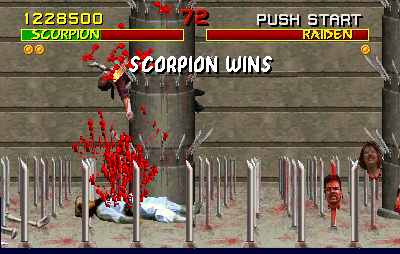
The Pit I Stage Fatality on Raiden in Mortal Kombat.
Stage Fatalities brought a new level of environment interaction within the series. A Stage Fatality occurs when a player uses a part of the stage or map to execute a unique Fatality that is not a standard character Fatality. Some examples of Stage Fatalities are having the victim fall into a pool of acid or a pit of razor-sharp spikes, or to be run over by a subway train. Stage Fatalities are present in the series from Mortal Kombat through Mortal Kombat Gold, Mortal Kombat: Deception's Puzzle Kombat, Mortal Kombat: Armageddon's Motor Kombat and Mortal Kombat (2011), being absent from the series for several years.
Death Trap
Mortal Kombat: Deception and Armageddon feature a modification of the traditional Stage Fatalities, the "Death Traps". Death Traps do not need a special button combination as the opponent only needs to be either standing or hit in a particular spot on the stage. Unlike previous Stage Fatalities, Death Traps can be initiated anytime during a round and only require the opponent to make contact into them, resulting an instant victory. However, if they are not executed in the decisive round, the fight does not end, going on to the next round. This action acts as a ring out.
Hara-Kiri
The new kind of "Anti-Fatality" introduced in Deception is the Hara-Kiri. The Hara-Kiri (which is a type of Japanese ritual suicide, that literally means belly cut, practiced when some person brings shame to his/her own family) is a move in which the defeated player kills him/herself upon defeat at the end of the last match, rather than be finished off by their opponent. This still results in a win for the character who was victorious in battle, it is just seen as an incredibly stylish way to go out. It is the first and so far only time in the Mortal Kombat series in which the defeated player is allowed to perform a finishing move. Each character has a different combination that can only be performed if the input corresponds to which character is defeated. The Hara-Kiri made its debut in Deception and seems to be a popular feature with the fans, although is not included in Mortal Kombat: Armageddon due to the limited Kreate-a-Fatality feature.
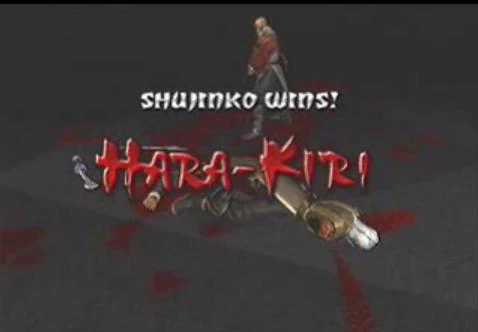
Shujinko's Hara-Kiri.
Although it has been available only in Deception, some previous MK games showed homicidal-suicidal Fatalities. The first one being one of Kabal's finishing moves in Mortal Kombat Trilogy using a button combination for his Animality from Mortal Kombat 3 was a self-decapitation finisher which allowed various glitches if the extended Fatality time is entered, including the decapitated head turning into Kano. Another one was Cyrax's "Self-Destruct" from Mortal Kombat 3/Ultimate/Trilogy/Gold/Advance; Cyrax, a cyborg, enters a code on to his arm panel and moments later explodes along with his opponent in a manner reminiscent of the ending of the first Predator movie. Smoke, in MK3, went farther with his Fatality since he destroys the whole planet with his bombs, including himself and his opponent. In MKG, Cyrax borrowed this Fatality from Smoke together with his own while Smoke adopted Cyrax's self-destruct as his Hara-Kiri in Deception. Raiden, in Deception, also has a Fatality in which he sends electricity to his opponent, who explodes. The electricity then returns to Raiden, exploding him as well. In Mortal Kombat (2011), Cyber Sub-Zero has a Fatality where he jumps onto an opponent, freezes himself with them, and both explode to ice bits (though the opponent only had the bottom half of his body intact).
Kreate-A-Fatality
For Mortal Kombat: Armageddon, the Fatality concept was completely revised. In all previous games, Fatalities and finishing moves were in the form of a button combo, activating a scripted animation sequence. In Armageddon, this system was replaced with a new Kreate-A-Fatality (KAF), or "custom chain-Fatality" system. After defeating an opponent in two rounds (with default settings), players are given a limited amount of time to perform one of several violent moves (such as ripping an organ out or snapping their neck) attributed to a button and direction combination. The time then resets and the player can perform a second move, but the timebar decreases more rapidly after each move. The longer a player is able to continue the chain, the higher ranking his Fatality receives; "Killer" Fatality, "Brutal" Fatality, "Evil" Fatality, etc. It is possible, with enough practice and , to pull off a Fatality of up to ten moves or possibly higher. It is also possible to "fail" the Fatality by running out of time before performing a final finishing move (such as ripping the opponent's head off). If time runs out before the player can end the chain with a final fatal move, no rank or reward is given and the Fatality is not counted, regardless of how many moves were completed.
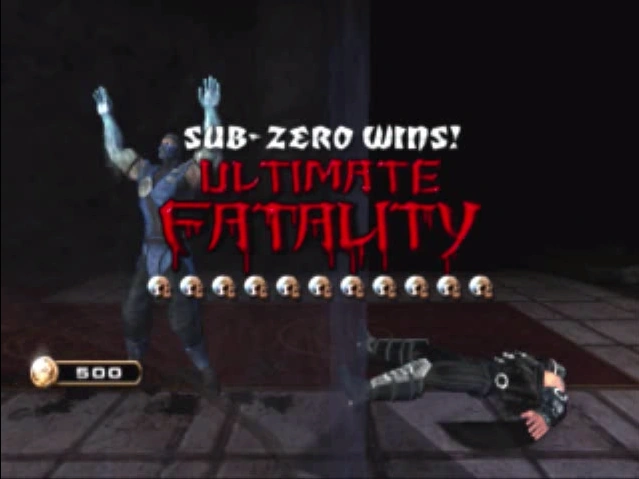
Sub-Zero doing an Ultimate Fatality.
This new system required that other forms of finishing moves, such as Deception's popular Hara-Kiri self-Fatalities, be left out of Armageddon. This was met with a mixed reaction, some fans preferring the more interactive nature and freedom of the Kreate-a-Fatality system, and others missing the previous games' character-specific ending moves and alternatives to killing the opponent. Also, originally, there were individual character-specific Kreate-a-Fatality moves for each character, with other characters unable to access them, but this idea was dropped somewhere along the way, and in the final product all characters' pool of moves are identical, except for Shokans (Goro, Sheeva and Kintaro) and beast characters (Moloch, Blaze, Onaga and more) with the only exception being Motaro, since he has the normal characters' moves.
Seasonal Finisher
Mortal Kombat 1 has introduced the concept of Seasonal Finisher, each of them corresponding to a certain holiday. So far, 3 have been shown: the Halloween Finisher, the Thanksgiving Finisher and the Winter Finisher.
- Halloween Finisher: The victor puts a carved pumpkin on the opponent's head, then various bugs and millipedes emerge from the pumpkin and start crawling all over the opponent's body. The opponent starts to panic as they start slapping their chest in an attempt to squash the bugs. As they fall to their knees, the victor kicks them in the head, decapitating them and sending the head crashing into a house door (ringing the doorbell) with the "Happy Halloween" plate on it.
- Thanksgiving Finisher: The victor uses a tablecloth to transition to a holiday table with various items of food on it. They smash the opponent's mouth onto the edge of the table, ripping it open and making them fall onto a chair, and the victor shoves mashed potatoes into their mouth, then smashes a pie into their face and forces a roasted turkey into their mouth, knocking them over as their stomach inflates. Finally, the victor stomps with both feet on the opponent's stomach, making them vomit continuously as their eyes pop and the top of their head explodes from the pressure.
- Winter Finisher: The scene transitions to a snow-covered forest where the victor grabs a large candy cane and smashes it against the opponent's head before driving the sharp remains through their back, pinning them to the ground. Then a sleigh drawn by Netherbeasts (rather than reindeer) runs them over, and their head is cut off with a sharp runner. General Shao, dressed as Santa Claus, catches the head in a basket and drives off, shouting "Ho-ho-ho! Merry Christmas!" to the player.
Creation
The Fatality concept originated from various developers' wishes to further emphasize victory at the end of a match, so much as to rub it in the loser's face, although Steve Beran himself stated in a G4 interview that he wondered if it was possible to "rip a guy's heart out". Ed Boon and his fellow staff often come together to collaborate on ideas of different Fatalities often derived from movies, especially those from Japan.
The effect of dismemberment simply came from digitally editing body parts of the actors. The charred skeleton sprite came from a small skeleton figurine, animating it via stop-animation and adding fiery effects and resizing it to match the actors' size. In the History of Fatalities, the original figurine was stated to have been destroyed from constant bending, the only remnant existing being the arm, the main part used for MKII's burning animation. The bloody effects were digitally drawn on the actors when body parts were edited off. Kung Lao's Hat Slice vivisection effect was done by capturing footage of the actor falling to one side, cutting the images in half and then mirroring it.
For the gruesome audio used for finishers, the audio staff employs the use of food or substances and records the sounds. Celery or hard fruit like apples are utilized for crunching and snapping bones while stirring, dropping, blowing into, or pulling thick gelatin (often with a plunger) is used for tearing flesh, leaking or gurgling blood.
Film
- In the first movie Mortal Kombat, Shang Tsung consumes the soul of his opponent, leaving behind a Fighting Monk's corpse. He then says: "FATALITY!"
- In Mortal Kombat: Legacy Season I, Baraka uses his Blade Lift Fatality on one of King Jerrod's decoys, and Cyrax performs a Fatality on Hydro, decapitating him with a forked blade from his wrist. In Season II, several Fatalities are performed by the various kombatants of the tournament: Kenshi telekinetically thrusts his sword Sento through Ermac's heart, Kitana decapitates Mileena with her Fan Slice Fatality, and Scorpion performs the classic Spine Rip Fatality on Sub-Zero.
- In the 2021 Mortal Kombat film, Liu Kang declares "Fatality. For Kung Lao" after defeating Kabal using a fire dragon, though this move is actually his Enter the Dragon Fatal Blow from Mortal Kombat 11. Additionally, various other characters defeat their opponents using classic Fatality moves, see here for a complete list.
Trivia
- Contrary to popular belief, the Fatalites introduced in the original Mortal Kombat arcade game in 1992 were not the first time a video game depicted blood and gore or at least controversial content. A primitive arcade driving game as far back as 1976 called Death Race, has the player's car run down "gremlins" (which are humanoid figures) who are fleeing the vehicle, and if hit, a loud scream is heard and are replaced with tombstones. Although blood is rarely seen prior to MK, the 1986 light gun arcade game Chiller is known as one of the first, if not the first violent video game ever to show gore, as one level, the torture chamber, clearly depicts dismemberment and pools of blood. However, the first Mortal Kombat did start the popularity of such games in the United States, as Death Race and Chiller were both unsuccessful due to most arcade owners refusing to purchase them.
- The Fatalities (and similar moves) are a huge cult following amongst fans of the Mortal Kombat franchise, with some enjoyed the fighting game series solely to see the exciting finishing moves being executed due to their brutal violence.
- The Fatality concept was listed #8 on ScrewAttack's "Top 10 OMGWTF Moments"
- In addition, Screwattack also created the list "Top 10 Mortal Kombat Fatalities". Some of them included Scorpion's Spear Shot from Deadly Alliance (Number 4, nicknamed 'Party Popper') and Quan Chi's Leg Beatdown from MK4 (Number 9).
- Screwattack also made the list "Top 10: Worst Mortal Kombat Fatalities". Some of them included Quan Chi's Neck Stretch from Deadly Alliance and Liu Kang's Flipping Uppercut from the first Mortal Kombat, as well as the censored versions of MK vs DC Fatalities.
- In MK 2011, before the characters perform a Finisher, they interestingly do a "battle cry"-like position (e.g. Scorpion gets to a slide-like pose and shouts fiercely; Jade plays with her staff saying "Too easy."; Johnny Cage says "Watch this!"; and Kratos unsheathes his Blades of Exile, even if the Finisher does not use them at all).

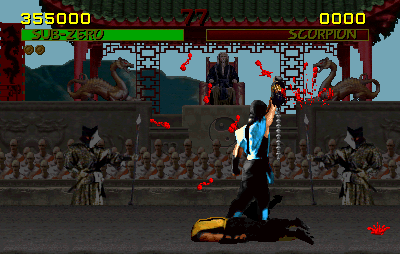
The notorious then-shocking Spine Rip Fatality from Sub-Zero (executed on Scorpion) in the original Mortal Kombat, believed by many to be the main reason of the ESRB's founding.
- When the Entertainment Software Rating Board was founded in 1994 as a result of growing depiction of violence and controversy in video games following the releases of Mortal Kombat as well as Doom and Night Trap, after the 1993 U.S. Congressional hearing, it quickly gave the original arcade fighting game (and all later mainline games) the rating of Mature (M), deeming the game too violent for audiences under the age of 17. It's worth noting that, in the United States, the ESRB has no legal standing to prevent the sale of violent video games to minors, and therefore many people under the suggested age were able to play the game. Arcade owners were asked to monitor the ages of players, although only a few actually did.
- It is widely believed that the ESRB originated thanks to Mortal Kombat's Fatalites, specifically Sub-Zero's infamous Spine Rip move, with it popularly seen as among the reasons, if not the main reason for its founding.
- Ironically, the Spine Rip is Ed Boon's favorite Klassic Fatality move in the series.
- It is widely believed that the ESRB originated thanks to Mortal Kombat's Fatalites, specifically Sub-Zero's infamous Spine Rip move, with it popularly seen as among the reasons, if not the main reason for its founding.
- The original Mortal Kombat game is the only title in the entire series not to have the iconic bloody "Fatality" graphic like the ones that appear onscreen when the finishing move is performed in later games. It instead shows a simple green text below the scoring saying "Fatality".
- There are nine characters in the series who have never received unique Fatalities: Blaze, Chameleon, Daegon, Darkseid, Meat, Mokap, Moloch, Onaga and Taven.
- In the racing game Trials 2: Second Edition, if the player bails out from the bike or crash and manage to kill the rider, a voice will say "Fatality!", a nod to the Mortal Kombat series.
- In the SNES versions of MK3 and UMK3, the attract mode allows opponents to be finished.
- Similarly in MK4, characters could also be finished, but the screen will fade to black and superimpose the Fatality logo on the screen right before any graphic detail is shown.


Gallery


Videos
External link
- GameFAQs' Mortal Kombat codes, move lists and Fatalities
- Mortal Kombat Armageddon: History of Fatalities - YouTube